Tuesday, 31 December 2019

Road to PhD Part 2: 2018

At the end of the first 12 months of a PhD, a formal document (usually 10,000 words) and a presentation of about 40mins are required to summarise the research to date. At AUT it is referred to using the term PGR9. It forms a checkpoint and milestone, after which, if successful, the provisional PhD student becomes a PhD candidate. One thesis type is thesis by publication (pathway 2), pathway 3 is through practical work artefact and thesis. But presenting work-in-progress can assist in prepping work and refining ideas (almost as thesis by presentation). Two main academic events acted as milestones to my present work, which in turn creates material for the thesis: the AUT Symposium 2018 and the Nga Pae o te Maramatanga MAI Doctoral Conference 2018.

In addition, I undertook a number of activities and creative projects that occur in the intersection of comics, children’s books and indigenous storytelling.


Creative projects and activities. Copyright Zak Waipara 2018


The Stolen Stars of Matariki with Miriama Kamo, Penguin’s Oh Boy: A Storybook of Epic NZ Men (with a bunch of epic NZ illustrators), Cardboard Campus from AUT Makerspace, a Comics Workshop in Rawene (Hokianga Book Festival), the Ko Rongowhakaata Exhibition book, and a shout out from Te Papa Museum.

Saturday, 29 December 2018

Road to PhD Part 1: 2017

In April 2017 I enrolled in a PhD in Art & Design at AUT, but the road to actually beginning was long - it took most of the year to find suitable supervisors and write the proposal (PGR2). However, once the proposal was submitted in October it was accepted within two weeks, with an official start date of January 2018. Two main events contributed to formulating directions for the research project: the 3rd Asia and Oceania Regional IBBY Meeting in Thailand, and the Storylines National Children's Writers and Illustrators' Hui 2017, which led to me writing a well-received article for The Sapling.


Copyright 2017 Zak Waipara. Bangkok road, presentation

Copyright 2017 Zak Waipara. Sapling article, Hui illustration.


In addition, I undertook a number of activities and creative projects that occurred in the intersection of comics, children’s books and indigenous storytelling, which also fed into my PhD journey. These include: a Maui comic book for the Auckland City Council Book Bus, a Storylines Notable Book Award for  the Maui - Sun Catcher book, a writing and drawing workshop for Auckland Writer's Festival, the Chromacon Indie Arts Festival, a Auckland City Council Matariki Story event, the Storylines South Auckland Tour, moderating an Auckland Library Comic Panel talk, an Auckland Game Dev Meetup panel on indigenous voices, and an animation for Te Papa Tongarewa on Rongowhakaata’s first encounters with Captain Cook.


Copyright 2017/2016: Photo - Storylines, Book - Oratia

Copyright 2017: Photo - Chromacon, Comic- Zak Waipara

Copyright Zak Waipara 2017

Copyright 2017 Storylines

Copyright 2017 Zak Waipara

Copyright 2017 Auckland City Council
Copyright 2017 Auckland Game Dev

Copyright 2017 M. Mulipola, L. Chen, S. Orchard, Z. Waipara

Copyright 2017 Zak Waipara

Saturday, 30 December 2017

The End is the Beginning

NZIBBY asked me if I would be able to provide them with a Season's Greetings card to end 2017. I opted to depict my favourite summer destination - Waiotahe Beach, Opotiki.

Postcard. Copyright 2017 Zak Waipara


I also added in an appropriate Maori proverb, well-loved by my father, the poetic version of the English translation is also his.

The real deal! Copyright 2017 Zak Waipara

Wednesday, 1 November 2017

Ōhakō Exhibition

Last year I was involved with an exhibition celebrating the Rongowhakaata iwi. Te Papa Tongarewa museum has for the last few years been hosting exhibitions from different tribal regions around NZ. Now it is the turn of the Rongowhakaata iwi. 


Copyright 2017 Zak Waipara


The first stage was local exhibitions at each of the marae around Manutuke and Gisborne, which I affiliate to all of them through my iwi connections, but our family was asked to contribute to Ōhakō Marae. The wharenui, Kiko-ote-Rangi (open unto the heavens), is unadorned by carvings, so there was some concern about what we could exhibit. The hapū decided that since many of the uri (descendants) were artists and musicians that we could show both traditional and contemporary examples of our craft. 


Copyright 2017 Zak Waipara


I decided my contribution could be a motion graphics piece to illustrate a short piece of oral history. It could also double as a very low-key proof of concept project, essentially using motion graphic techniques e.g. mixture of animated elements, kinetic type, to tell non-fiction stories, which is something I have become more interested in. The process involved listening to an hour’s worth of audio recorded at a whakapapa wānanga session, to find a short section that would work as a self-contained story, then transcribe that part of the audio. I edited the audio down further, to remove some extraneous sounds, and some tangential stories that might work better in another style. This became a three-minute piece, but also has the potential be developed more fully at a later stage (for instance, using those other excised stories). The style I adopted was based on modified carvings with an illustrative approach (flat rather than 3D), but also to have these located on a physical plane, mimicking the walls of a house. The various font treatments were meant to replicate tukutuku weaving panels. 


Copyright 2017 Zak Waipara


The second stage was to curate items from all the marae into a smaller exhibition at Tairāwhiti Museum, that opened September 15th 2016. The third and final stage for this exhibition opened at Te Papa in Wellington in September of this year. I was asked to contribute an animated project to this – which I will talk about in a later post!

Friday, 16 June 2017

IBBY Congress & Storylines 2016

IBBY (or the International Board on Books for Young People) “is a non-profit organisation representing an international network of countries and people, mostly volunteers, dedicated to bringing books and children together. It is the only international body working comprehensively for children’s books.” 


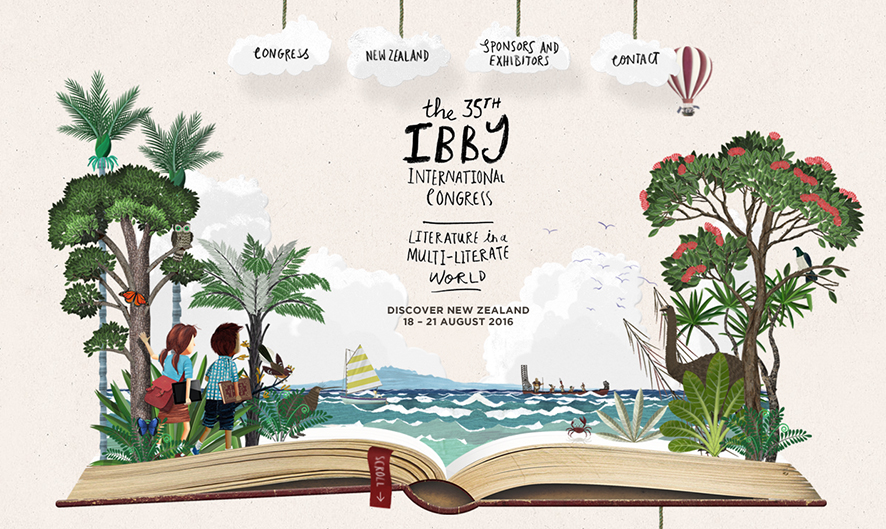
Design for the conference home page.


Many years in the organising, New Zealand was lucky enough to be the host country this year. The theme of this conference was “Literature in a multiliterate world” with three sub-themes - Global, local and indigenous literature, Diverse literary forms and formats, and Engaging readers. 


Opening ceremony. Photo copyright Zak Waipara

Given my own interest in all these areas, I was keen to be involved and was accepted to present a poster (a visualisation of the presentation I gave in the UK) and also asked to appear on a panel: Illustration Unbound: Narrative Art Across Genres, Age Groups, Cultures, and from Paper to Pixels and Beyond. It was chaired by Leonard Marcus a “historian, critic, exhibition curator, and lecturer in the field of children’s books and their illustration.” 


Poster display. Photo copyright Zak Waipara


Leonard took great care in chairing the panel – contacting us all ahead of time to consider the purpose and how best to make use of our time. I was lucky enough to meet him and have a chat beforehand as well. You can hear a Radio NZ interview with Leonard here


A treatise on the importance of picture books by Leonard Marcus.


My fellow panellists were Roger Mello (Brazil) and Bronwyn Bancroft (Australia). I was tasked with being a minder for Guest Delegate Bronwyn Bancroft, It was very heartening to hear about her work involving her Aboriginal community. Here is a link to an interview on Radio NZ. 


Some of Bronwyn's amazing work. Photo copyright Zak Waipara

Roger Mello discussed his children's work dealing with serious themes in his home country, such as child labour. It echoed a point raised by Witi Ihimaera in his rousing keynote address (a real call to action) on the first day of the conference, when he advocated for stories that tackled the pressing issues facing the next generation! He asked, "who is writing the story for the child whose island is about to be swamped by rising sea levels?"

Peter Dowling of Oratia Press (looking after Roger Mello at the conference) was in the front row of the audience and reports on the panel here, and the IBBY UK delegation also has a nice summary of the event and Katarina Kokanović from Croatia reports here

The best thing about any conference like this is being surrounded by a vast group of new and interesting people from all over the world who are passionately interested in this one area. For me it was personally inspiring, and I feel following on from the experience, all this time later, I am still coasting on a new wave of creativity. 

Giant pop-up book. Photo copyright Zak Waipara

STORYLINES 2016 

The following week, I hit the road as part of Storylines 2016 Northland Tour, with Anne Dickson, Tim Tipene, Maria Gill and Lesley Dowding. What a fantastic group of people to be on tour with! It was a slightly surreal departure in Auckland seeing Henry Rollins in the hotel foyer in which we were gathered. As always we were shown the hospitality of Northland schools, and met with passionate teachers and creative and talented children. It all wound up with a Family Day event hosted at the Kaitaia library.

The amazingly designed Kaitaia library.

Saturday, 3 December 2016

TERNZ 2015 & HERDSA 2016

A belated update on two education based conferences I attended as part of professional development and ongoing research interests, in this case where teaching practice and curriculum design intersect with industry experience. These events are useful for providing insight and inspiration for new approaches to learning and teaching, especially because coming from industry into tertiary teaching presents challenges as well as solutions. 

Poster of Project-Based Integrated Learning approach.


 The first conference, TERNZ, was held at AUT in Auckland in November 2015. TERNZ focuses on “teaching and learning research in higher and tertiary education that is open to academics from all disciplines. The theme of every TERNZ conference is learning in higher education: our learning, our students' learning, our colleagues' learning.” The session at TERNZ were practical, very hands on and interactive in this regard. My colleague Nick Konings and I co-presented both a presentation and poster based on his work in designing the curriculum for a new Bachelor of Animation, and bringing together Project Based Learning and Integrated Learning under a term he coined: Project Based Integrated Learning (PBIL). Nick focused on the approach and I presented case studies of student work arising from this methodology. 


Poster of 'Making by Doing' approach to curriculum design.

The second conference, HERDSA, was held at Fremantle, Australia, with the theme for the conference being The Shape of Higher Education. Once again, myself and Nick appeared there co-presenting a presentation, and I presented a poster (co-designed with my colleague Lena Yaroshenko). This time the topic concerned a methodology of curriculum design employed by a number of staff in the animation faculty, in which lecturers work on projects in a similar fashion to students, as a means of testing the efficacy of the programmes being designed – which I referred to as Making by Doing. HERDSA was an interesting experience, since many of the topics that were raised by various institutions are things relevant and already being approached inside the philosophy and curriculum we were developing. The abstract can be viewed here.

Saturday, 25 June 2016

Electricomics!

This post has been a long time coming.... Last year, on the 14th of October 2015, I attended The Comic Electric: A Digital Comics Symposium, which was held at The University of Hertfordshire in the UK.

Outside the University of Hertfordshire (c) Zak Waipara 2015


The Electricomics platform project was driven by renowned comic writers Leah (the Thrill Electric) and Alan Moore (Watchmen, V for Vendetta, League of Extraordinary Gentlemen, Promethea), The Electricomics project was launched in May 2014, with funding from the UK's Digital R&D Fund for the Arts.

As the project neared the conclusion of its research and development stage, The Comic Electric symposium was held, led by Leah Moore and Daniel M. Goodbrey, to share findings, and expand discussion and debate around the field of digital comics research.  Leah's own digital comic project Sway is really quite impressive in taking advantage of the iPad's ability to detect the motion of the device and use it as a narrative component! Can't wait to see what else she might come up with...

Participants, including myself, presented papers across a wide range of topics that relate to comics scholarship and digital media. I presented my own research paper Otea: Transmission and Transmedia, based on my Masters research into transmedia comics and cultural transmission. Otea is a comic project for kids I have been working on for a while. Here's a nice concise summary of the talk itself, as reported by one of the attendees.

Leah Moore's post on Alan Moore's Facebook page


The Symposium was highly enjoyable and extremely informative. I won't attempt to cover the entirety of the proceedings but will mention briefly a few notable speakers.

My fellow panellists, Liz Dowthwaite and Vitor Blotta, covered Web Comic Communities and Comics as Journalism in Brazil, respectively. Liz's blog can be found here – she very kindly mentions my project. Her own topic is also her PhD research.

Matt Finch's presentation covered the possibilities offered by participatory style comic workshops working with different groups around the world, including time spent in Aotearoa NZ. It was great to see the contribution from a Christchurch librarian as well, never thought I would travel all that way to see te reo Maori comics in the UK...

Matt covered the Symposium on Twitter, with links to my slideshow.

Craig Smith, whose work on Motion Comics I quoted in my thesis, was the final speaker of the day and focused on Motion comics, including the Madefire platform pioneered by Dave Gibbons (of Watchmen fame). I chatted to Dave very briefly - it was cool to meet him in person.

I also had the chance to chat in person with Craig Smith on the 30 minute train ride back to London.

I went back to Hertfordshire Uni the next day to chat with Daniel M. Goodbrey (senior lecturer in Narrative and Interaction Design at the School of Creative Arts), to meet staff and talk about their teaching programmes, and to compare notes on our course back in NZ. Some of Daniel's interactive comic projects can be seen here –  he is really showing what can be done with the form.

It was seriously cool to fly to the UK and be part of a ground-breaking experience.