Monday, 25 January 2016

Comics, Libraries and Games

This is a post covering a range of events in the latter half of 2015 with which I was involved, including lots of collaborations with Auckland City Libraries for their comic book month. (My involvement came about through my association with Animation College.)

First out of the gate was a 'miniature ComicCon', dubbed LibraryCon, which took place on Sunday 6 September 2015 at Panmure Community Hall. LibraryCon featured cosplay, indie comics, pop culture crafts, and interestingly a group of budding game developers, including some reps from IGDANZ or the NZ chapter of the International Game Developers Association.


Zak, Dora and Jerwin © Zak Waipara

The focus for our group was to exhibit staff and student comic artwork, and included sketches for the public from Animation College students from lecturer Thaw Naing's Drawing Club (known as ACDC). Following on from this event, some of the comic work went up on display in the Central Library for the month of September.


Thaw sketching at the booth. © ZW

I was then invited to participate in The Panel (a comics discussion panel), chaired by Neil Curtis of Auckland University. This was a broad ranging discussion about diversity in the NZ comic 'scene'. This took place on 16 September 2015 in the Whare Wananga, Level 2, Central Library. It was a chance to hear about a new comic project - Three Words, an anthology featuring 60 female comic artists, that came about in response to a lack of representation of women in curated comic events.

Michel Mulipola, who had all the best lines, coined the phrase 'mansploring' to explain this inability to locate women comic creators! Thanks to the staff at Central Library, especially Courtney Ross, for organising all of the above.

Three Words postcard and a book gift from the Library. © ZW

Finally, I facilitated a Manga/Comic drawing workshop for children and teens at Mt Roskill Library, on Saturday 19th September. The real stars were the Bachelor of Animation students – Teahi, Joanne, Taylor and Michelle, who ran segments on specialised topics and provided their own customised resources.


Joanne, Zak, Michelle, Taylor and Teahi. © Mt Roskill Library

This was a good opportunity for our students to plan a lesson and practice presenting their ideas and communicating some drawing principles clearly – which helps their own learning as well.
Many thanks to Marion and Po Yee of Mt Roskill Library for hosting this event.

It's great that Auckland City Libraries celebrate Comic Book Month every year, and always come up with new ways to engage readers and budding writers and illustrators.

Examples of student Manga art and drawing principles. © ZW

Games Event

AUT #NZGDC15 – NZ Game Developers Conference, September 2015 

Then I attended my first conference devoted to games, and was really interested to see the diverse ranges of topics, in particular Serious Gaming (games for social change). Terry Fleming from Auckland University presented her version, COMETS (Collaboration on Maximising the impact of E-Therapy & Serious gaming), realised by Maru Nihoniho of Metia Interactive (who I would eventually meet in person at a Maori Digital Cluster Hui in December). This is a fascinating project looking at serious games for mental health and healing – well worth a look. Keep up with the project on Facebook:

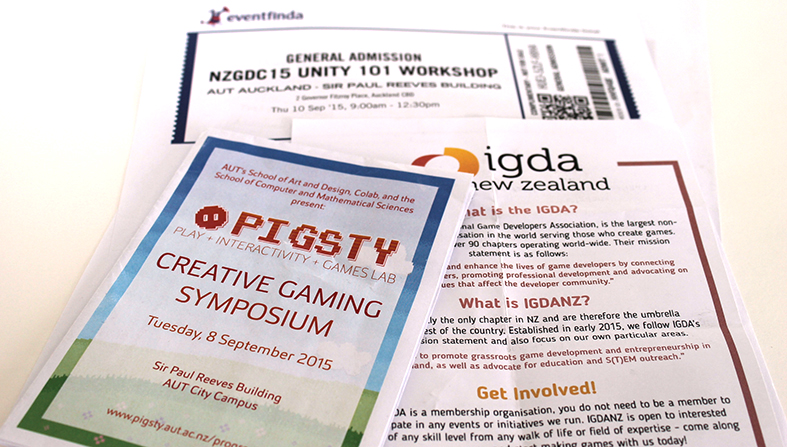
The following day I participated in a Unity 101 Workshop at the Conference – it was amazing to see how quickly something resembling a game level could be built.

 © Zak Waipara

Sunday, 19 July 2015

A Positive Turn of Events


Copyright 2015 Zak Waipara

Just a quick catch-up on a busy year so far with a presentation on Comics and Transmedia for the monthly Transmedia NZ Meetup (15 April). Had some interesting questions and suggestions posed for the future direction of my Masters project in taking it out to the real world. This was followed by the launch of my comic, Otea: Rock of Ages, at Chromacon (18-19 April) where I renewed old acquaintances and made new ones too. Really enjoyed reading James Davidson's comic series Moa, it has a really timeless feel, as if it has always existed, almost like an historical artifact. My daughter enjoyed reading them as well and we await the next issue. Then, as part of the Auckland Writers Festival, I ran a workshop for 40 intermediate and secondary school students on creating mythical characters (13 May) and gave a presentation as part of the Family Day (17 May). It was great meeting and talking with the audience afterwards.


Copyright 2015 Zak Waipara

Finally I attended an awesome 1 day workshop with Andrew Gordon of Pixar (1 July). He also took some time out to visit the campus and featured as one of the guest speakers at Semi-Permanent 2015 (3-4 July). Being a practitioner undertaking research requires engagement with others, whether with an audience, or your peers or with those in industry. For that reason I find these events really rewarding in providing important touchstones.

Monday, 6 July 2015

Postcards from Ubud

The Ubud Writers and Readers Festival is once again gearing up. Here are some recollections of my visit there in 2014:


(c) copyright Zak Waipara 2015

(c) copyright Zak Waipara 2015

(c) copyright Zak Waipara 2015

(c) copyright Zak Waipara 2015

(c) copyright Zak Waipara 2015

(c) copyright Zak Waipara 2015

(c) copyright Zak Waipara 2015

For more info, the whole event is covered in more detail on Storify!

Wednesday, 3 December 2014

The Hunter (Redux)

Just a short post to acknowledge Tama's (my brother) win in the New Zealand Vodafone Music Awards for Best Roots Album. He tautoko ki taku teina! Here's a link to a pre-awards interview and a post awards one (starts at 2.38). 

It's also a chance to re-post an awesome image by a talented artist Eric Hiakita Cresswell, based on the characters from The Hunter music video. 

Image copyright Eric Hiakita Cresswell 2014.

In Eric's own words, the song “inspired me to do this quick sketch, imagining what the Hunter would look like when he's in his teens.” Eric is a graduate of Freelance Animation school (now Animation College), he is currently working as a Concept artist at a Gaming Studio in Wellington. Tau ke Eric!

Thursday, 23 October 2014

The Hunter

I have spent the last few months working on an animated music video for my brother's song 'The Hunter'. The music video premiered on the TV show Native Affairs on Maori TV, alongside an interview with myself and my brother. The full music video is now available to watch on Vimeo (see below). I thought it might be useful to detail the working process behind the video itself.


  “I don't have a narrative in mind, but the song is about the relentless search for happiness.” Tama Waipara


The original impetus for my chosen treatment came from a desire to reference in some way the universe-style cover image I designed for Tama’s album Fill Up The Silence, where the track The Hunter comes from. On that project, I used Adobe After Effects (a compositing and animation program) to build a 3D-space background. Therefore, the night-sky and its stars as theme seemed appropriate. Through word-image association I saw a chance to pay homage to the constellations of Orion the Hunter and its companion Canis Major, but in a remixed Maori context, rather than the classical one – recasting these constellations as proto-characters, as a sort of an every-man and every-companion, albeit with Maori overtones. 

The notion of sampling such ideas via my specific viewpoint (which includes a Maori outlook), can be viewed as cultural remix - a blending of my Western and Indigenous heritage. Remix as a creative methodology was employed in my Honours and just completed Masters projects. This naturally led to a re-use of ideas, because I was searching through some old diaries and came across sketches (from 2008) which seemed to fit the theme of the video - as did a sketch for an unused idea that was proposed for a motion graphic opening title sequence back in 2010, but never got used. The motion graphic idea was based on the use of tukutuku patterns set inside holographic road-signs. The sketches were of a dog face that had been designed to conform to the style of a carved pou (post), and an accompanying tekoteko face. 

Also, because Maori have a very specific cosmology & astronomical system associated with the stars (which I spent some years researching), I cast the main protagonist as a proto-polynesian Hunter, devoid of many of the most obvious Maori stylings e.g. tamoko (facial tattoos), taonga (jewellery), weaponry such as taiaha, mere, patu, tewhatewha, etc., but still retaining some elements such as the top section of a rain cape, bird spear, tatua (belt), and piupiu (albeit simplified for animation purposes into a single piece). 

Tama even thought this timeless look might indicate some future world, rather than the past. This idea of his proved to be useful in rethinking some aspects of the video, but also useful in recasting constellations inside this idea of cultural remix. Perhaps if the story takes place in the future, it’s also no longer on Earth. 

A kuri or Polynesian dog is cast as a secondary character. This type of dog, which had a very specific and quite distinct look, is now extinct in NZ, though a model exists in the Te Papa Museum which I used for reference. Interestingly, I saw some dogs with similar characteristics on a recent trip to Bali;  I’m sure they would have common ancestry with the kuri.

From listening to the lyrics I couldn’t but help see the song in terms of a story, one that included all the various ideas I wanted to use. Tama describes the song as being: “...originally from the Sir Plus album demos and then the Hunter section was added in New York when the feel of the song changed. Also the general intention of the song changed slightly with lyrics, from defeated to empowered and hopeful...” “Even though the universal theme is love throughout and the pursuit of it, I think the more general theme is happiness and the ‘the hunt’ for it.” So from this initial idea, alongside the specific lyrics and the song’s driving rhythm, a quest-style narrative emerged.


Storyboards for The Hunter. Copyright Zak Waipara 2014

In brief, the two protagonists, a young boy and a kuri, are seen at different times hunting. It isn’t clear immediately what they are hunting for, but it is implied for food, shelter, etc. They pursue these things alone, with the boy moving right to left, and the dog left to right. At the end of the story they meet each other, and it is shown that ‘company’, someone to share life’s travails with, holds promise in the ongoing quest for ‘happiness’. 

The protagonists are rendered in a 2D illustrative style, drawn from a blend of Maori and anime influences, although the anime visual style tends to reduce the ethnic look of characters, and I wanted to retain it. The backgrounds are generally flat, though textured, mottled and coloured to suggest environment, and lit using virtual lights to simulate the time of day, again using a 3D environment to stand in for a 2D animated world. This is in order to provide a somewhat reduced, but not entirely blank canvas for the introduction of kinetic typography to be read against. Kinetic type works best when placed against clean backgrounds. Where this project differs from pure kinetic typography is in the inclusion of animated characters as narrative elements. 

This project was particularly difficult because it was a hybrid form, part animated story, part kinetic type motion graphic, which are not usually combined, and I had to try and find some middle ground between the two forms. The fonts (apart from the album typefaces), a main component of any kinetic type project, were sourced from one main font designer. Motion graphics seem a natural vehicle to work with non-literal elements, therefore this project provided a chance to include Maori motifs; the constellations based on Maori Rock Art design, the tukutuku patterns reimagined as 8-bit style holograms, and kowhaiwhai patterns flowing out into the universe. 

Illumination is a key feature throughout the animation - the narrative begins in twilight, we then see simulated firelight, glow-worm caves, fireflies, the starry heavens, a satellite (originally intended to be a comet), and finally sunrise. This illumination mirrors the journey toward understanding and warmth. The typography takes on the style of the light-sources, such as star constellations. Indeed, some of Tama’s early ideas included “UV light and puppet/dancers.” In this vein, the animated figures include detailed walk-cycles that are synched to the beat and rhythm of the music. Tama also talked about the use of light-streaks at the point that video moves up into the night sky. 

Working within remix often engenders a sense of fun, and the upbeat track denotes a playful quality that Tama was keen to emphasise. Taken as a whole, the various integrated ideas create an idiosyncratic look that matches the unique song’s inspiration. I tended to follow the rhythm and the vocals to set the pace and narrative, but one crucial scene needed reworking (based on Tama’s feedback), to better capture the flavour of new musical instrumentation that begins to make itself apparent. The solution was to have new visual elements that represented the introduction of these musical addtions, and Van Gogh’s Starry Starry Night served as a sort of inspiration, so these forms took on the appearance of digital swirls and fireworks. 

I am also interested in narrative that opts for different ways to solve story conflict, rather than just physical supremacy, so the plot’s peaceful conclusion has been designed around this idea. The final appearance of a new character, a pukeko, provides a moment of bathos, which is used to punctuate the whole piece. This notion of using bathos seems to be a natural and recurring theme for me, as I used it in the first Rock of Ages prologue.

Finally, before the premiere, a series of teaser videos were made, that repurposed the six tukutuku holograms as stand-in glyphs for the six letters used in the two words: The Hunter. He mihi mahana ki NZ on Air mo te tautoko ki te kaupapa nei!

Monday, 22 September 2014

Teaser

Native Affairs will screen this video on Maori Television, tonight 8pm (29/09/2014).


Sunday, 7 September 2014

Ubud 2014

Ka mau te wehi! I have been lucky enough to be invited to appear at the Ubud Writers and Readers Festival this year alongside a talented group of NZ authors and artists, especially acclaimed Maori author Patricia Grace! More information about the festival, its origins and purpose can be found here. This is an amazing opportunity to meet creative people and take part in a significant festival in a part of the world I have never visited! My brother, Tama Waipara, will also be participating, the festival will be timely given we are collaborating on a creative project which I hope to be able to debut soon, as well as reflect on the working process behind it in an upcoming post. He mihi mahana (many thanks) to the NZ Embassy Jakarta for sponsoring our inclusion in the event. 

I will be speaking on a panel alongside some really well respected authors/illustrators Mem Fox, Alison Lester, and Briony Stewart (their books are sitting in my daughter's bookshelf!) about the various creative conundrums that one may face when working in the medium of children’s books. More information about my role and participation can be found here. I will also be running an illustration workshop based on character creation where inspiration will be drawn from cultural heritage and mythology. My personal work draws on my own Maori heritage, viewed somewhat through a contemporary lens. The idea of the workshop arose out of this interest and is an outgrowth of my recently completed Masters research project. My transmedia story, Otea, is a new creation born from traditional Maori mythology. 

Robert McKee, in Story: Substance, structure, style and the principles of screenwriting (1999), wrote “the archetypal story unearths a universally human experience, then wraps itself inside a unique, culture specific expression.” (I attended a film/screenwriting workshop of McKee's in 2004 at Auckland University). Put simply, a story should be universal in appeal but culturally specific. This sums up my own approach to my work, and my appreciation of many other stories from around the world. The Studio Ghibli films show aspects of Japan’s cultural specificity, some more overt than others, and are born from an authentic worldview. I first saw Princess Mononoke in 2000 at the New Zealand Film Festival, described by one reviewer as “as a landmark of the genre.” The character of Prince Ashitaka is thought to be based on an indigenous group (the Emishi) who once lived in northern Japan. Spirited Away also contains strong cultural references, with aspects of fairytale and mythic rules throughout. Many of these elements are drawn from Shinto religious practices including a belief in animism – something shared by many indigenous cultures which aligns quite naturally alongside my own understandings of Maori stories. At the Survive and Thrive 2013 conference hosted at AUT, I attended a presentation by Keiko Bang, in which she expressed her view that “New Zealand's spirituality resonates strongly with spirituality across Asia.” In rereading Maori legends, I see certain recurring themes prevalent in other cultural tales such as redemption myths via spiritual pilgrimages, reminiscent of the Chinese tale Journey to the West. In Secret of Kells, a beautifully stylistic animated film that references Celtic culture, history and art, the newer Christianised world sits alongside the older pagan one. 

Such works convinced me that my own project Otea: Rock of Ages, born from a lifelong fascination with Maori myths and legends, held some promise as a story project and indeed value as an entry point into exploring the larger world of te ao Maori (the Maori world). 


Sketches and some finished artwork. © Copyright 2014 Zak Waipara


In this example of sketches (above) showing the character design and development of my adaption of the fearsome Kurangaituku (the birdwoman is a famous character from Maori legend), inspiration has come from te taiao (the natural world), in that the plumage and colouring was styled on the New Zealand Wood Pigeon or Kereru (sometimes referred to as Rupe in traditional myths – the form that Maui could change into by way of magic). This lends the character some grace, beauty, as well as physical strength. Her plumage has also been designed to create a feathered costume (and likely takes some inspiration from superhero attire). 

The workshop is intended to explore exactly this approach, encouraging all creators to examine their own cultural heritage, and use self‐exploration of identity as one possible creative pathway, to develop their personal artistic voice. I say one possible pathway, as artists/authors are multifaceted and don't like to be pigeonholed (no pun intended), but this avenue has proved to be personally fulfilling, and results in honest and authentic work.